Faster construction
Blocks stack in a day or two on a prepared footing. No form panels to set, strip, clean and return.


H2O Pool Construction / Build methods
We build pool shells from insulated concrete forms — the same system used in high-performance custom homes. The result is a faster build, a stronger shell, and a pool that costs far less to heat every season it's open.
Why we build this way
Insulated concrete forms are already used across residential and commercial projects — retaining walls, garden walls, fire features, entire homes. Over the past few seasons, more of our clients have asked about using the same system for a swimming pool.
It makes sense. ICFs speed up shell construction, and the foam that stays in place after the pour blocks the majority of the heat a conventional pool bleeds into the surrounding soil. Lower heating bills are the obvious win. The quieter one is season length — an insulated pool comes up to temperature sooner in spring and holds it later into autumn.
Industry estimates put heat loss through a pool's walls and floor at up to 80%, because soil conducts heat far more efficiently than air. Across that much surface area, continuous insulation is the sensible answer. Insulated concrete form industry data
The material
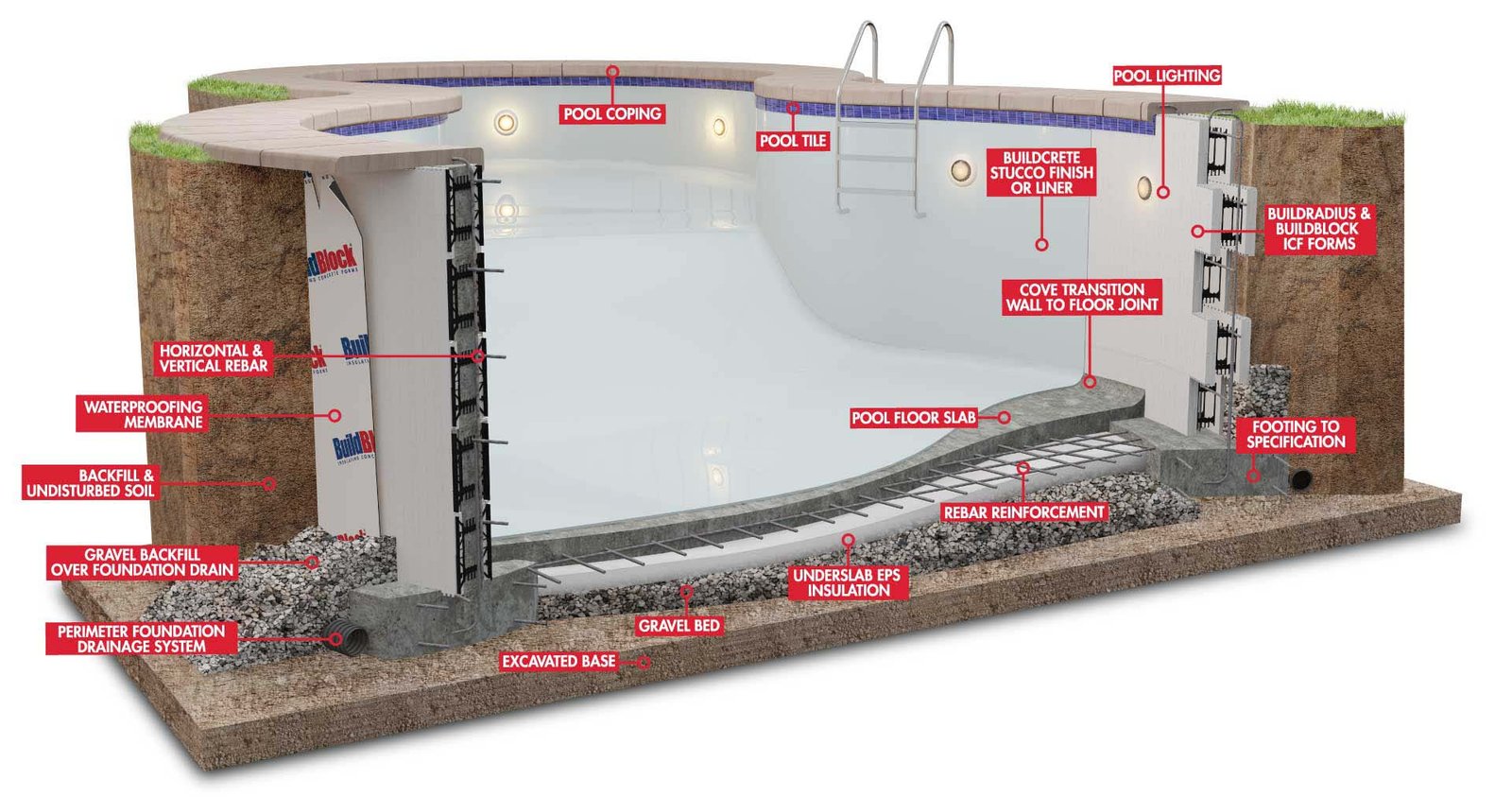
An ICF is a hollow block of expanded polystyrene (EPS) foam held together with plastic webs. Blocks stack dry, reinforcing steel drops into the cavity, and standard ready-mix concrete is poured from a normal truck. The foam never comes off — it becomes permanent insulation on both faces of the wall.
Because the foam is machine-formed, the finished wall is unusually flat and square. That matters at finishing time: flat walls take plaster evenly, and clean corners and joints are exactly what a PVC membrane liner wants. Certified membrane installers commonly back their work with a 10-year waterproof warranty.
Curved walls, free-form shapes, tanning ledges, benches, spa spillovers — foam cuts and shapes easily, so the design isn't boxed in by the forming system.
What you get
Blocks stack in a day or two on a prepared footing. No form panels to set, strip, clean and return.
Forms are light enough to move by hand, which keeps crews small and access tight sites without heavy plant.
Radius forms let us build sweeping walls cleanly, instead of relief-cutting and over-bracing straight blocks.
Offcuts get reused as under-floor insulation and infill. Very little leaves the site in a skip.
Webs hold horizontal bar at set spacings, so reinforcement lands where the engineer specified it.
Consistent wall faces mean less making-good before plaster, membrane or tile goes on.
No specialist gun, no rebound, no shotcrete crew. Ordinary pump-and-pour with ordinary trucks.
The foam isn't a wrap that degrades — it's structural formwork that stays in the wall permanently.
Heat stays in the water instead of the soil, which is weeks of extra use at each end of the year.
The sequence
Construction follows standard ICF wall practice, with a floor system and waterproofing detail built for permanent water contact.
Interior options
Coating systems have moved on considerably. Several are now formulated specifically for ICF substrates in permanent water contact, which means the shell can be finished without a separate render coat.
A fibre-mesh reinforced cementitious plaster applied straight onto the EPS. Fully waterproof, trowelled to a smooth finish, and pigmented or painted to the colour you want. Our default recommendation for most builds.
Single application · no base renderPurpose-made ICF coating ranges pair a bonding basecoat with a waterproof topcoat, for both vertical walls and pool floors. Useful where a specific texture or colour range is being matched across the deck.
Vertical & horizontal useA waterproofing basecoat over the shell, then a conventional pool plaster or pebble finish on top. Choose this when you want a familiar plaster look and feel with the insulation still working behind it.
Familiar finish · insulated shellFlat ICF walls and square corners suit welded membranes well. Fitted by a certified installer, these systems commonly carry a 10-year waterproof warranty.
10-year warranty availableProject types
Most ICF pools go in alongside high-end custom homes — owners who chose ICF for the house for its durability and running costs tend to want the same for the pool. But we also build them as community and club pools, where year-round running cost is the whole argument, and as retrofits to existing homes.
If you're already building with insulated concrete forms, using the same system for the pool keeps one trade, one material and one set of details across the whole project.
Start the conversation
Send us the site, the shape you have in mind and roughly when you want to swim. We'll come back with a build approach, a shell timeline and a realistic figure.
Heat-loss and energy-saving figures are industry estimates for insulated versus uninsulated pool shells; actual performance varies with climate, soil, pool size, cover use and equipment. Wall thickness, reinforcement and drainage details are always set by the project engineer.